
 English
 Español
 Pусский
 Français
 Deutsch
 日本語
日本語 한국어
한국어 العربية
 Nederlands
Flangia del recipiente a pressione
A pressure vessel flange is a critical mechanical component used to connect sections of a pressure vessel, attach covers or nozzles, and provide secure access for inspection, maintenance, and cleaning. In industrial systems, pressure vessels are designed to contain liquids or gases under internal pressure, and the flange plays an essential role in maintaining the integrity and safety of the entire assembly. Because it must withstand high pressure, temperature fluctuations, and possible corrosion, the flange is manufactured to strict engineering standards and selected according to the specific service conditions of the vessel.Structurally, a pressure vessel flange is usually a circular ring with bolt holes arranged evenly around its perimeter. It is commonly paired with a matching flange and sealed using a gasket placed between the two mating surfaces. When the bolts are tightened, the gasket is compressed, creating a tight seal that prevents leakage. The quality of this sealing system is extremely important, especially in applications involving steam, chemicals, oil, gas, or other hazardous substances. Even a small leak can lead to operational failure, safety risks, or environmental damage.Pressure vessel flanges are available in several types, including weld neck flanges, slip-on flanges, blind flanges, socket weld flanges, and threaded flanges. Among these, weld neck flanges are widely used in high-pressure applications because their tapered hub provides excellent stress distribution and stronger resistance to deformation. Blind flanges are used to close off openings or vessel ends, while other flange types are selected based on installation requirements, pressure rating, and ease of assembly. The choice of flange depends on design pressure, temperature, material compatibility, corrosion resistance, and applicable industry codes.Materials used for pressure vessel flanges vary depending on operating conditions. Carbon steel is common for general-purpose service, while stainless steel, alloy steel, and other specialty materials are used in more demanding environments. In corrosive or high-temperature applications, material selection becomes especially important to ensure long-term durability and safe performance. Surface finishing, heat treatment, and machining accuracy also influence the flange’s strength and sealing capability.Manufacturing pressure vessel flanges requires precise machining and strict quality control. The flange face must be smooth and accurate to ensure proper gasket seating. Bolt holes must align correctly, and dimensional tolerances must comply with recognized standards. During inspection, tests such as visual examination, dimensional checks, and material verification are often performed to confirm that the flange meets design requirements.In practical use, pressure vessel flanges simplify assembly and disassembly. They allow engineers and maintenance personnel to open the vessel when internal inspection or repair is needed, without cutting or permanently damaging the structure. This makes them highly valuable in industries such as petrochemical processing, power generation, pharmaceuticals, food production, and water treatment.Overall, a pressure vessel flange is more than just a connecting part. It is a key safety and performance component that helps ensure pressure containment, easy maintenance, and reliable operation in demanding industrial environments.
Prodotto
Classificazione:
-
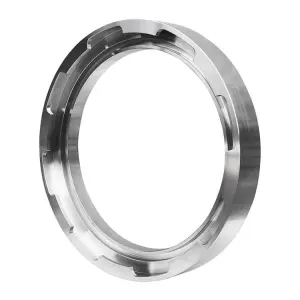
Flangia per recipienti a pressione di alta qualità per serbatoi e sistemi di apparecchiature industriali
La loro classificazione: Flangia standardVisualizzazioni: 174Numero:Tempo di rilascio: 2026-07-01 11:18:53Le flange per recipienti a pressione di alta qualità sono componenti critici per serbatoi e sistemi di apparecchiature industriali, progettati per garantire tenuta sicura, resistenza all'alta pressione e stabilità operativa a lungo termine. Realizzati in acciaio al carbonio, acciaio inossidabile e acciaio legato, sono conformi agli standard internazionali come le specifiche ASME Sezione VIII e ASTM. Queste flange sono ampiamente utilizzate nell'industria petrolifera e del gas, petrolchimica, di produzione di energia, di lavorazione chimica e marina. Grazie alla forgiatura di precisione e alla lavorazione CNC, offrono durata eccellente, resistenza alla corrosione e prestazioni affidabili in condizioni estreme, rendendoli essenziali per operazioni sicure ed efficienti dei recipienti a pressione.
Notizie
Classificazione:
-
[industry news]Flangia standard per sistemi di collegamento di tubazioni in...
2026-07-14 03:36:38 -
[industry news]Carbon Steel Neck Flange for Pressure Vessel Systems
2026-07-26 03:41:28
Caso
Classificazione:
Nessun risultato di ricerca!
Video
Classificazione:
Nessun risultato di ricerca!
Scarica
Classificazione:
Nessun risultato di ricerca!
Reclutamento
Classificazione:
Nessun risultato di ricerca!
Prodotti consigliati
Nessun risultato di ricerca!



 Whatsapp
 Telefono